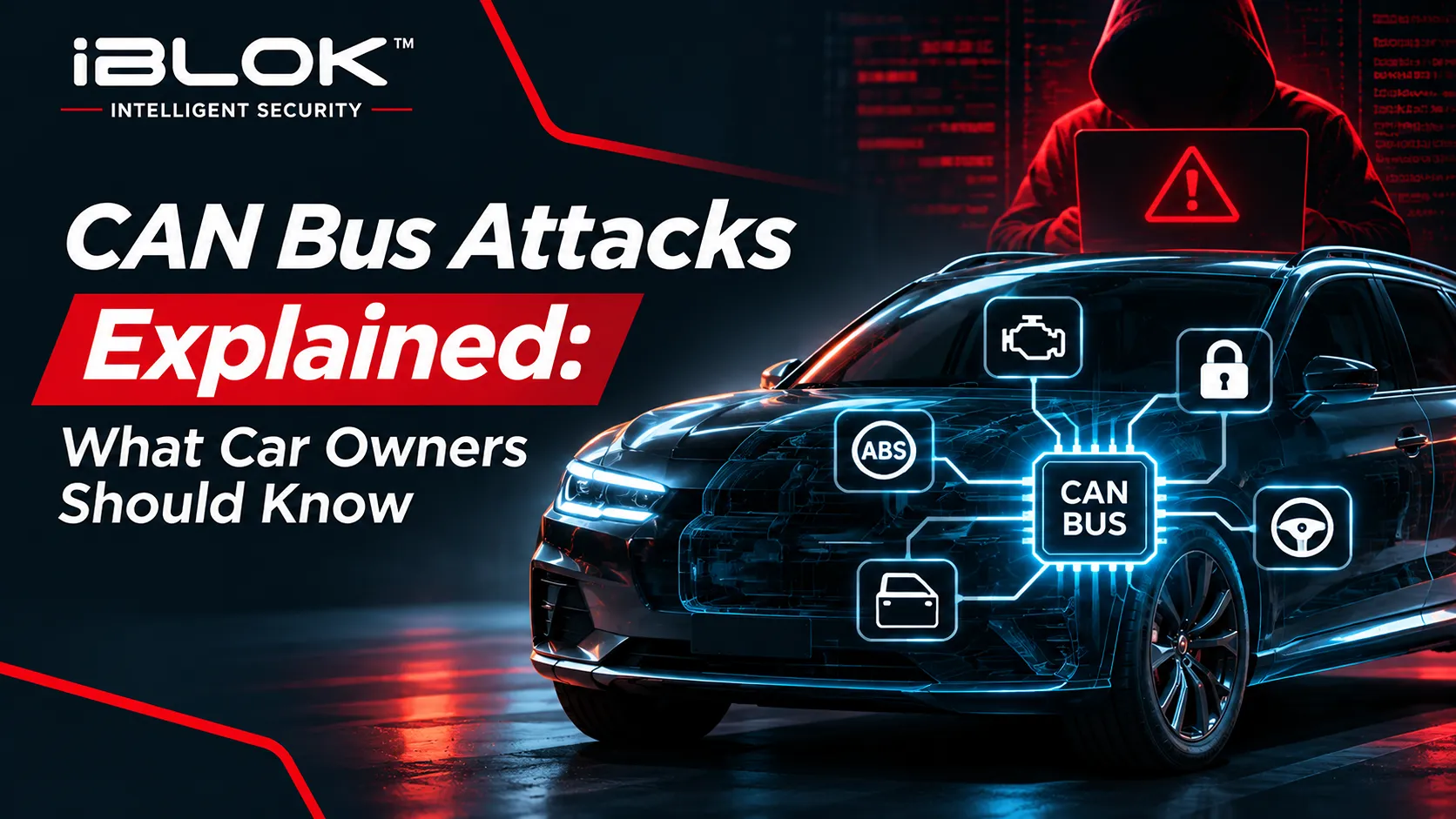
Modern vehicles are more connected and technologically advanced than ever before. From keyless entry and electronic ignition systems to advanced driver assistance features, today's cars rely on sophisticated computer networks to operate.
But this technology also introduces new security challenges.
One growing concern is the CAN Bus attack, a type of electronic vehicle attack that exploits communication systems inside modern cars. Unlike traditional car theft methods that rely on physical keys or forced entry, CAN Bus attacks target the electronic communication network that allows different vehicle components to communicate.
Understanding how these attacks work, why they are a concern and how to improve your vehicle's security can help you make smarter decisions about protecting your car.
At iBLOK, we believe vehicle security should evolve alongside modern theft techniques. Here's what every car owner should know about CAN Bus attacks.
CAN stands for Controller Area Network. It is a communication system that allows different electronic control units (ECUs) inside a vehicle to exchange information.
Think of the CAN Bus as the nervous system of your car. Just as nerves carry messages between different parts of the human body, the CAN network allows electronic components to communicate and coordinate their functions.
Modern vehicles use CAN Bus communication for systems such as:
Instead of requiring separate communication connections between every component, the CAN Bus provides a shared network through which electronic modules exchange messages.
This makes modern vehicles more efficient, but it also creates potential opportunities for electronic exploitation if the network is not adequately protected.
A CAN Bus attack occurs when an unauthorised person gains access to a vehicle's internal communication network and attempts to manipulate the messages exchanged between its electronic control units.
The original CAN protocol was designed primarily for reliable communication rather than modern cybersecurity. Traditional CAN communication does not inherently authenticate every message sender or encrypt all messages.
As a result, if an attacker gains access to the network, they may be able to introduce unauthorised messages that other connected components could interpret as legitimate.
In vehicle theft scenarios, criminals may exploit these weaknesses to interfere with factory security systems, manipulate access-related functions or attempt to make a vehicle recognise unauthorised commands.
Unlike conventional theft techniques, these attacks can sometimes take place without obvious signs of forced entry.
CAN Bus attacks generally involve gaining access to a vehicle's electronic communication network and exploiting weaknesses in how its components communicate.
Here are some of the techniques associated with CAN Bus attacks.
CAN injection involves introducing unauthorised messages into a vehicle's communication network.
If the receiving electronic control unit accepts these messages, an attacker may be able to influence certain vehicle functions.
Some documented vehicle theft techniques have involved accessing wiring connected to vehicle components and injecting messages that imitate legitimate security-related communication.
Electronic Control Units (ECUs) communicate using messages across the CAN network.
In a spoofing attack, an attacker attempts to make a message appear as though it originated from a legitimate electronic component.
If the vehicle's systems cannot properly verify the source of the message, they may accept unauthorised instructions.
A replay attack involves capturing previously transmitted communication and attempting to transmit it again to trigger an action.
Without appropriate authentication and freshness checks, some communication systems may be vulnerable to this type of manipulation.
A Denial-of-Service (DoS) attack attempts to disrupt normal communication by overwhelming or interfering with the vehicle's network.
This can prevent legitimate electronic components from communicating properly and may cause certain vehicle systems to malfunction.
Although not every CAN Bus attack is designed to steal a vehicle, these techniques demonstrate why automotive cybersecurity is becoming increasingly important.
One of the most concerning applications of CAN Bus vulnerabilities is electronic vehicle theft.
Some modern vehicles use interconnected electronic systems to manage door locking, key recognition and engine authorisation.
If criminals successfully gain access to the relevant communication network and exploit weaknesses in the vehicle's security architecture, they may attempt to manipulate these systems.
In certain documented theft cases, attackers have accessed vehicle wiring through external components and used specialised electronic equipment to inject unauthorised CAN messages.
This can potentially allow criminals to bypass parts of the vehicle's factory security process.
The important thing to understand is that these attacks do not affect every vehicle in the same way. Vulnerabilities depend on the vehicle's make, model, software and electronic architecture.
To understand other methods criminals use, read our guide: Can Thieves Bypass Factory-Fitted Car Security?.
Both CAN Bus attacks and relay attacks target modern vehicle security, but they exploit different technologies.
A relay attack focuses on the wireless communication between a vehicle and its key fob, whereas a CAN Bus attack targets the vehicle's internal electronic communication network.
CAN Bus AttackRelay AttackTargets the vehicle's internal communication networkTargets wireless communication with the key fobMay involve unauthorised CAN message injectionExtends communication between the vehicle and keyCan exploit weaknesses in electronic vehicle architectureExploits keyless-entry communicationMay involve physical access to vehicle wiring or a compromised electronic moduleTypically uses wireless relay equipmentCan potentially interfere with access-related vehicle functionsCan potentially make the vehicle believe the key is nearby
Both techniques demonstrate why relying exclusively on traditional factory security may not be sufficient for every modern vehicle.
Learn more about how relay attacks work and how to protect your vehicle.
Modern vehicles contain an increasing number of electronic systems that communicate with one another.
While manufacturers implement different security measures, several factors can contribute to potential CAN Bus vulnerabilities.
Traditional CAN communication does not inherently verify the identity of every device transmitting a message.
This can create opportunities for unauthorised messages to be introduced if an attacker gains access to the network.
Modern cars often include Bluetooth, Wi-Fi, telematics, connected applications and other electronic interfaces.
These technologies improve convenience but can also introduce additional potential entry points if they are not properly secured.
Vehicle diagnostic interfaces, including OBD-II ports, allow technicians to communicate with vehicle electronics for maintenance and troubleshooting.
If these interfaces are accessed without authorisation, they may create opportunities for certain electronic attacks.
As vehicles become more advanced, the number of connected modules and communication pathways increases.
Protecting these systems requires security measures that consider the entire vehicle architecture rather than relying on a single security component.
Although vehicle owners cannot directly control every aspect of their car's electronic architecture, there are practical steps they can take to improve overall security.
Factory-fitted security systems are an important starting point, but an additional immobiliser can introduce another layer of driver authentication.
A PIN-based immobiliser requires the authorised driver to enter a unique code before the vehicle can be driven.
This means access to the vehicle or possession of a key alone may not be sufficient to authorise driving.
Avoid allowing unauthorised individuals to access your vehicle's diagnostic connections.
Where appropriate, ask a qualified vehicle security specialist about additional OBD protection options compatible with your vehicle.
Vehicle manufacturers may release software updates to address security vulnerabilities and improve electronic system performance.
Follow manufacturer recommendations and have updates installed by authorised professionals.
Poorly installed aftermarket electronics can introduce additional electrical or communication problems.
Always use qualified installers who understand your vehicle's electronic architecture and manufacturer requirements.
No single security device can protect against every possible vehicle theft technique.
Consider combining an immobiliser, tracking system and appropriate physical security measures for a more comprehensive approach.
A PIN-based immobiliser introduces an additional authorisation requirement before a vehicle can be driven.
Rather than relying exclusively on the factory key or remote signal, the system requires the driver to enter a personalised PIN.
This creates another security checkpoint between gaining access to a vehicle and being able to drive it.
The iBLOK CAN Bus Immobiliser is designed around this approach, combining discreet vehicle integration with personalised PIN authentication.
Key features include:
It is important to understand that a PIN-based immobiliser is an additional vehicle security measure, not a universal cybersecurity solution. Its protection depends on the system design, vehicle compatibility and installation.
For owners of modern vehicles, investing in additional vehicle security can be a sensible decision.
Premium vehicles, keyless-entry cars and models targeted by organised vehicle theft may benefit from additional protection beyond factory-fitted systems.
A CAN Bus immobiliser with PIN authentication offers a discreet way to introduce another layer of driver authorisation without relying on additional remotes or complicated mobile applications.
The right solution depends on your vehicle and the type of protection you want.
Explore our guide to the Best Car Security Systems in South Africa to understand how different security technologies can work together.
CAN Bus attacks highlight an important reality: modern vehicle theft is no longer limited to breaking windows, forcing locks or stealing physical keys.
As vehicles become increasingly connected, their security systems must evolve too.
Understanding electronic theft techniques is the first step towards making informed decisions about protecting your vehicle.
iBLOK offers a smarter approach to vehicle protection through discreet CAN-bus immobiliser technology and personalised PIN authentication.
With no additional key fobs, no mobile applications and no monthly subscription fees, iBLOK makes advanced vehicle security simple and convenient.
Don't rely on your factory security alone. Add another layer of protection.
Visit iBLOK to explore the technology and check whether your vehicle is compatible.
Your vehicle. Your PIN. Your protection.