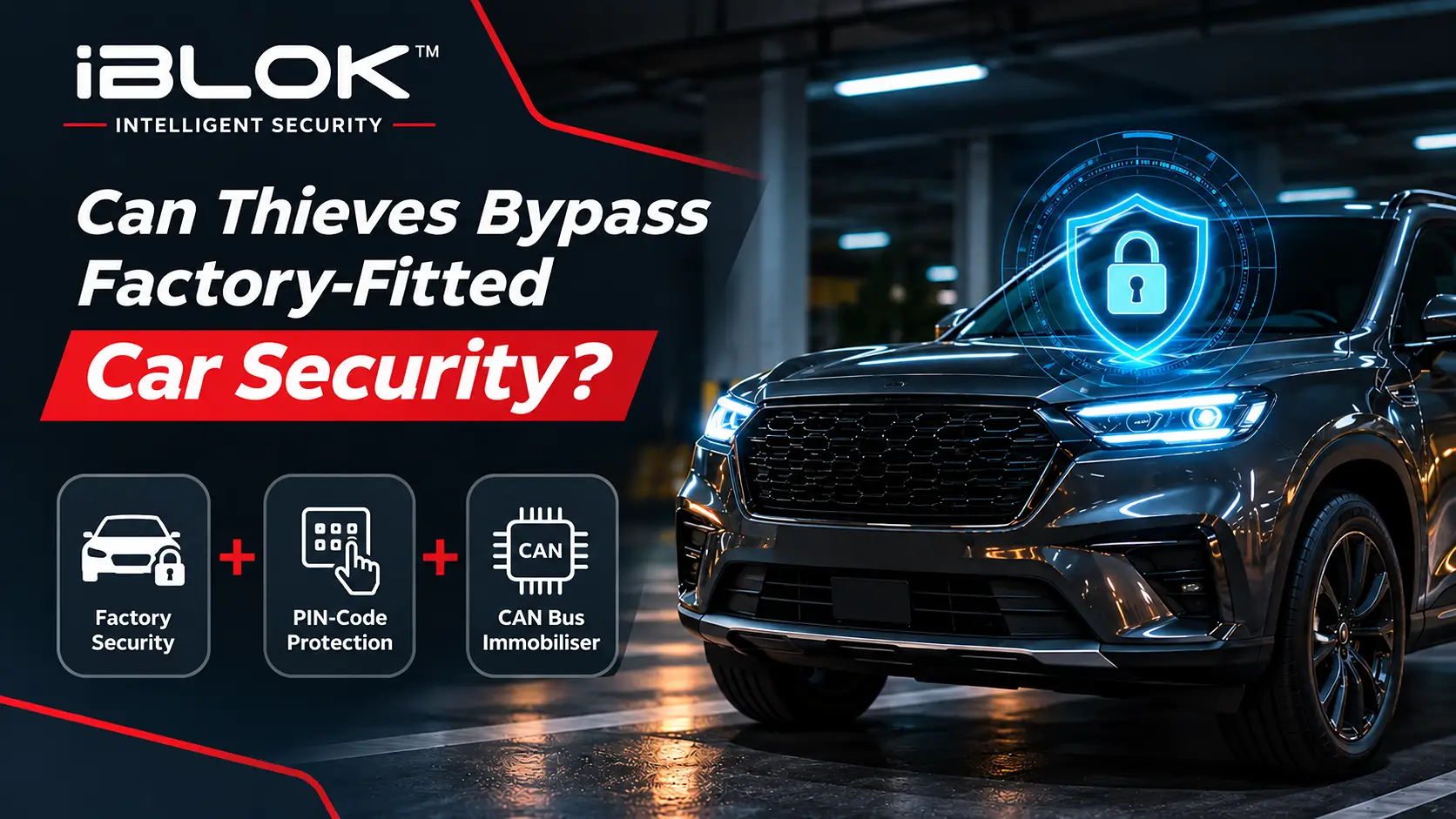
Modern vehicles come equipped with advanced security features designed to protect against theft. From factory-fitted alarms and electronic immobilisers to keyless entry systems and GPS tracking, manufacturers continue to improve vehicle security. But an important question remains: Can thieves bypass factory-fitted car security systems?
Unfortunately, yes. While factory-installed security systems provide a valuable first line of defence, they are not always enough to protect against today's increasingly sophisticated vehicle theft techniques.
Across South Africa, vehicle owners need to understand how modern car theft works and why additional vehicle security can make a significant difference.
Most modern vehicles include several built-in security features designed to prevent unauthorised access and engine starting.
These commonly include:
Although these technologies improve vehicle security, they rely on electronic communication and vehicle systems that may be targeted by criminals using specialised equipment.
Understanding modern vehicle theft techniques is the first step towards choosing better protection.
Relay attacks are a growing concern for vehicles equipped with keyless entry and push-button start systems.
Criminals use electronic equipment to capture and extend the signal from a vehicle's key fob. This can make the vehicle believe that its authorised key is nearby, even when the key owner is somewhere else.
As a result, thieves may be able to unlock the vehicle and start its engine without physically possessing the original key.
Modern vehicles use a Controller Area Network (CAN Bus) to allow different electronic components to communicate with each other.
Unfortunately, criminals can exploit weaknesses in vehicle communication systems to interfere with security functions and attempt unauthorised access.
This is one reason why traditional alarms and immobilisers may not provide sufficient protection against every modern theft technique.
The Engine Control Unit (ECU) is an important electronic component responsible for managing engine operations.
In certain vehicles, criminals may attempt to replace or manipulate electronic control components to bypass existing security protections.
Additional immobilisation technology can help prevent unauthorised vehicle operation even when criminals attempt to compromise the original factory security system.
Key cloning involves duplicating or compromising the digital information associated with a vehicle's authorised key.
If criminals successfully obtain the necessary authentication information, they may attempt to create an unauthorised key that the vehicle recognises.
This highlights why relying entirely on the original vehicle key may not always be enough.
Signal jamming involves disrupting wireless communication between a vehicle and its tracking or security equipment.
For example, a tracking device may struggle to transmit its location when its GPS or GSM communication is disrupted.
This is why vehicle owners should consider security solutions that do more than simply monitor or track a vehicle.
Factory-fitted immobilisers are an important part of modern vehicle security. However, they are generally designed around the manufacturer's original vehicle security architecture.
If criminals manage to exploit vulnerabilities in that architecture, the original immobiliser may not provide the additional independent protection needed.
This is particularly important for owners of expensive vehicles, luxury SUVs and popular models targeted by organised vehicle theft groups.
According to the South African Insurance Crime Bureau, relay attacks continue to be a concern for vehicles equipped with keyless entry and ignition technology.
Therefore, adding another layer of security is a sensible consideration for vehicle owners.
A stronger vehicle security strategy combines preventative technology with everyday security habits.
Here are some practical steps:
Most importantly, do not assume that having a factory-fitted alarm or immobiliser means your vehicle is completely protected.
A CAN Bus immobiliser provides an additional layer of electronic protection by controlling whether the vehicle can be operated without the correct authorisation.
Unlike conventional systems that primarily depend on a key fob or wireless remote, certain advanced immobilisers use an alternative authentication method.
This is where iBLOK offers a different approach to vehicle security.
iBLOK is an advanced CAN Bus immobiliser designed to help protect vehicles against modern digital theft techniques.
Rather than relying on a traditional remote or smartphone application, iBLOK uses a unique PIN-code sequence entered through existing vehicle buttons.
Here are some of its key features:
1. PIN-Code Vehicle Authentication
Drivers enter their unique PIN sequence using existing steering wheel, dashboard or window control buttons. Without the correct sequence, the vehicle remains immobilised.
2. No Wireless Signals
iBLOK does not rely on radio-frequency transmissions, key fobs or smartphone applications for its PIN authentication process.
3. Automatic Immobilisation
The system automatically arms when the vehicle ignition is switched off, helping ensure that protection is activated without requiring additional action from the driver.
4. Discreet Installation
Its compact design allows it to be installed discreetly within the vehicle's wiring, making the system difficult to identify.
5. OEM-Level Integration
iBLOK is designed for modern CAN Bus vehicles, with installation that does not require cutting factory wiring.
6. Simple PIN Management
Vehicle owners can change their PIN sequence and share access with authorised drivers when needed.
By introducing an additional authentication step, iBLOK helps make unauthorised vehicle operation significantly more difficult.
Vehicle theft can result in substantial financial and personal losses, even when insurance coverage is available.
Owners may still face insurance excess payments, vehicle replacement costs, administrative delays, alternative transport expenses and the inconvenience of being without their vehicle.
Investing in additional vehicle security can therefore be a practical way to reduce exposure to modern theft risks.
Rather than relying only on factory-installed technology, consider adding a security solution designed to address the challenges of today's digital vehicle theft methods.
So, can thieves bypass factory-fitted car security?
Yes. Modern theft techniques such as relay attacks, CAN Bus attacks, key cloning and signal jamming demonstrate why traditional vehicle security systems should not be considered completely foolproof.
For South African motorists, an additional layer of protection is worth considering.
Protect your vehicle with iBLOK. Discover how advanced PIN-code authentication and CAN Bus immobilisation can provide an additional level of security beyond your factory-fitted system.
Visit iBLOK South Africa to explore the technology and find out how to secure your vehicle.
Your vehicle deserves more than standard protection.